 Farshad Ghobadvand
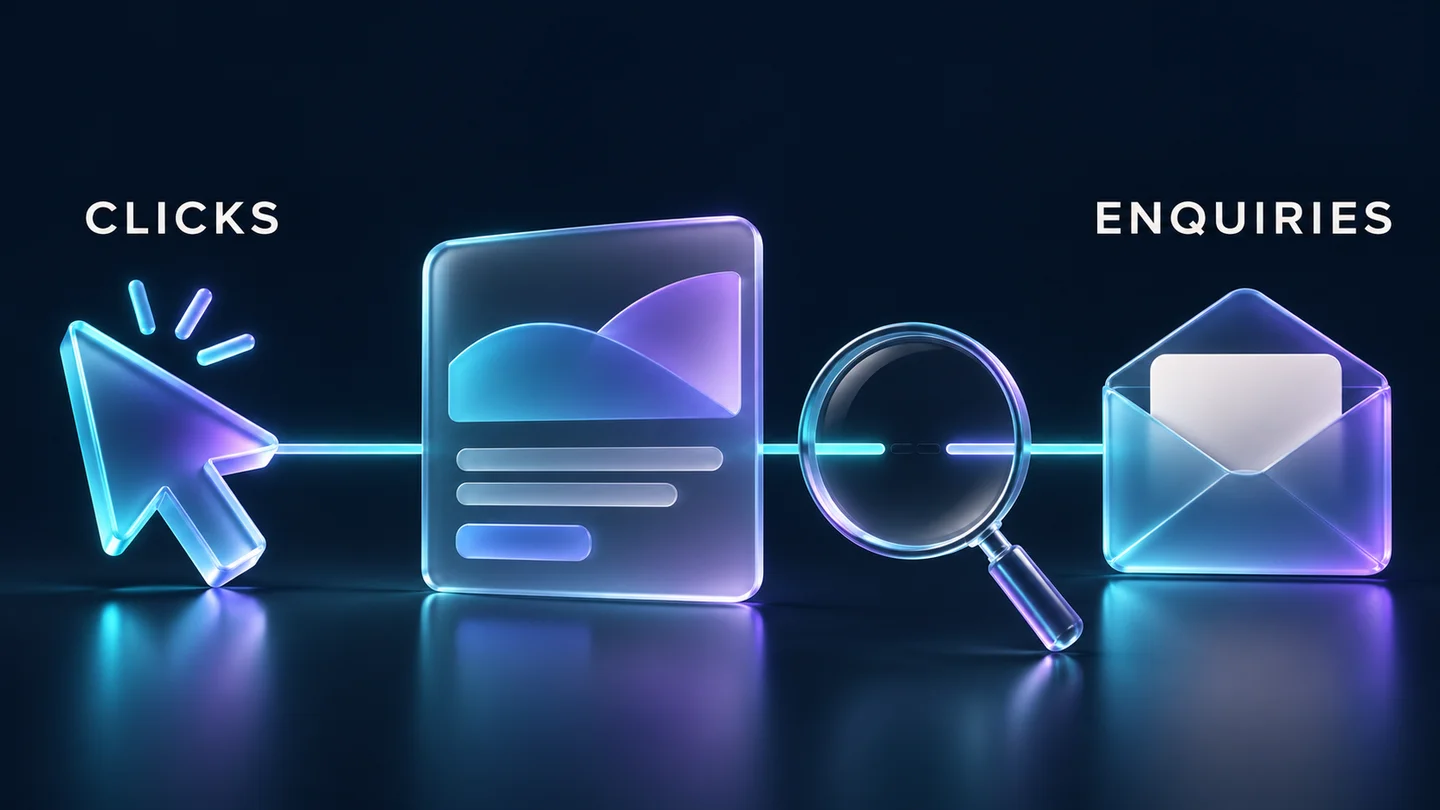
If Google Ads is getting clicks but your business is not receiving enquiries, investigate the path from the search to the person answering before buying more traffic. Check what counts as a conversion, whether the searches match your service, whether the landing page makes sense on a phone, and whether a completed enquiry actually reaches someone.
I’m Farshad Ghobadvand, founder of MarTech Studio. This guide helps a service-business owner decide what to ask a marketing manager to review. It focuses on Search campaigns and website enquiries; other campaign types and call routes need their own checks. Clicks alone cannot identify the cause, and a review cannot promise a particular number of customers.
Are you missing enquiries, or measuring the wrong action?
Start with the business record. Ask the person receiving calls, emails or CRM records which genuine new enquiries arrived during the review period. Separate sales requests from spam, existing-customer support and duplicates. Then compare the meaning of those records with the conversion actions in the advertising report. A contact-button tap is not proof that a message arrived or a conversation happened.
Google distinguishes primary conversion actions used for reporting and bidding under the applicable campaign goal from secondary actions used for observation. Custom goals have an exception: included secondary actions can also be used for bidding. Ask your manager which goals the campaign actually uses and what triggers each action, rather than judging it by an event’s reassuring name.
- Reported conversions but no received messages: investigate event definitions and delivery.
- Received enquiries missing from reports: investigate measurement and attribution.
- Received but unsuitable enquiries: investigate intent, offer and qualification.
Are the searches connected to the service you sell?
For Search campaigns, review the actual search terms rather than only the keyword list. Google’s search terms report shows searches that triggered ads, subject to privacy limits that omit some low-activity queries. A missing query is not proof that no related traffic occurred. Review the available evidence alongside campaign settings and the destination.
A service owner might want installation enquiries while some visitors want employment, training or do-it-yourself instructions. Those are different intentions even when they share a product word. Ask for examples classified by relevance, with a reason for any proposed exclusion. Do not automatically block every phrase that has not produced a conversion in a small sample.
Check the intended service area, language, device and network in the same review. Avoid combining campaigns with different objectives into one verdict. A low click price or a strong click-through rate cannot establish that the people arriving can buy the particular service you offer.
Can a suitable visitor understand the offer and enquire?
Open the actual advertised destination directly and review it on a phone. Can a visitor recognise the service promised in the ad, the area served, the next step and who operates the business? Check whether a cookie panel, overlapping element, confusing wording or unnecessary form requirement obstructs that task. A general homepage may not answer a specific service request.
Agree an authorised test of the enquiry route with the person who receives it. Check required fields, validation messages, the success message and the actual receiving inbox or CRM. W3C guidance calls for clear feedback about submission success or errors. A reassuring message on the page still does not prove that the business received the enquiry.
Document the observed problem before buying a replacement website. A focused correction may address a broken field or unclear service explanation; a larger structural limitation may require more work. The evidence should explain the proposed scope, rather than treating every disappointing campaign as a reason to rebuild.
What happens after the enquiry reaches your business?
A delivered message still needs an owner and a next action. Check who monitors the destination, how missed calls are handled, which language the reply requires and whether staff can identify the requested service. If nobody is responsible for the response, changing the ad cannot by itself complete that conversation.
Compare equivalent periods and allow for your actual customer decision cycle. Google documents reasons why ad clicks and Analytics sessions differ; those numbers are not expected to match one for one. Reporting differences alone do not establish fraud or prove a broken campaign. Keep the enquiry record, the advertising report and the follow-up outcome distinct.
My Airport Kia portfolio documents campaign management, CRM analysis and marketing systems within an ongoing dealership role. It shows the connected responsibilities and approved, sanitised interfaces. It is relevant experience for this kind of investigation, not evidence that another business will obtain the same outcome.
An example: choose the first investigation before changing the budget
Imagine a hypothetical service business promoting installation work in its actual service area. The owner sees clicks, but cannot find new requests in the shared inbox. This example describes a decision process, not a client result or a diagnosis of your account.
First, the manager checks whether the reported conversion means a button click or a completed submission. Next, the business authorises a labelled test and confirms its receipt. The manager reviews available search terms and compares the ad promise with the service page. Each finding should state what was observed, what remains uncertain and who can resolve it.
If the form fails, investigate that failure before expanding traffic. If the form works but the searches concern a different service, review targeting and message alignment. If suitable enquiries arrive but remain unanswered, fix the response responsibility. Several issues can coexist; do not claim that the first fault found explains every lost opportunity.
- Ask for the specific evidence behind the proposed change.
- Give the correction an owner and an agreed check.
- Review genuine received enquiries separately from taps and page views.
What should you pay a manager to review and improve?
Ask for a written scope covering the campaign, search terms, landing-page journey, conversion definitions and enquiry handover. Confirm the access required, proposed changes, approvals, implementation exclusions and review date. An initial discussion should establish the problem; it should not quietly become permission to change budgets or every connected system.
MarTech Studio’s current Google Ads management fee is CAD500 per month for building and managing up to five campaigns in one account, plus a one-time CAD250 setup fee. Each campaign above five adds CAD80 per month. Ad spend is paid separately to Google; applicable taxes are extra. Measurement checks are included, while new landing pages, development and complex tracking or CRM implementation are quoted separately and agreed first.
These are management prices, not a guarantee of leads or a standalone audit offer. If you want to discuss help, share your service, website, intended area and what you currently count as an enquiry. Use the Google Ads option in the consultation form. We can then discuss the relevant scope without asking you to send passwords or private customer records.
Key takeaways
- Investigate definitions, traffic relevance, the page and delivery before buying more clicks.
- A recorded conversion, a received enquiry and a qualified customer are different outcomes.
- Match the corrective work to evidence; agree implementation separately from management.
Sources & further reading
Primary guidance reviewed on November 27, 2026. The diagnostic order is my practical recommendation, not an account-specific audit or a claimed benchmark. The example is hypothetical; service prices describe MarTech Studio’s current offer. No customer data, personal test result or guaranteed performance is presented.